Thursday, December 11, 2008

Santa Smokes a Pipe #11 (1913)


A rare corncob-smoking Santa.

Wednesday, December 10, 2008

Vintage Christmas Ad (1964): Give him a Kaywoodie


The "*pipe smokers live longer" is a reference to the 1964 Surgeon General's Report on smoking. A couple of articles about this report can be read here and here.

Santa Smokes a Pipe #10 (1913)

Tuesday, December 9, 2008

Monday, December 8, 2008

Sunday, December 7, 2008

Saturday, December 6, 2008

Friday, December 5, 2008

Thursday, December 4, 2008

Wednesday, December 3, 2008

Vintage Christmas Ad (1940s): Santa smokes Edgeworth


Santa Smokes a Pipe #3 (1906)


A leather postcard. What a wonderful way to offend nannyist anti-smokers and PETA goons both at the same time.

Tuesday, December 2, 2008

Monday, December 1, 2008

Santa Smokes a Pipe #1 (1901)


NOTE: I first posted this series two years ago, in December of 2006, on another blog. I have seen nothing to make me change my original statements.
*****
Modern political correctness and rampant nannyism are revising history. Many contemporary renditions of Santa Claus have removed the pipe. I'm sure it's only a matter of time before someone re-writes "The Night Before Christmas" to remove the stump of a pipe clenched tight in his teeth.

Today and continuing through Christmas Day I will be posting a series of old portrayals of Santa Claus, one each day. No (or at least, minimal) commentary, just pictures.

The first item up is from 1901.

Saturday, November 29, 2008

Pipe superstitions

A superstition specific to pipe smoking warns that a pipe should never be lit from a burning lamp or candle, which, according to the French, will provoke a wife to argumentativeness, and possibly even infidelity. Blowing smoke rings is, however, a good omen said to promote the luck of both the smoker and those in the immediate vicinity. Among American Indians, smoking a pipe of peace is an important social ritual and no one must refuse to take a puff if the pipe is offered to them. The ceremony must be done in total silence--if anyone speaks, the pipe must be dropped at once. Disaster will befall anyone who attempts to smoke from it again.

--from Cassell's Dictionary of Superstitions by David Pickering
Just a little something from email inbox, thanks to Brer.

Featured Pipe Smoker (Art): Alchemist by Adriaen van Ostade


Alchemist by Adriaen van Ostade (1610-1685)

In this painting by Dutch painter Adriaen van Ostade, an alchemist tends his fire surrounded by his accoutrements and equipment. His clay pipe and spectacles lie on the stool behind him. Bad place, if you ask me. If he absent-mindedly sits down he'll break his pipe and his glasses at the same time.

Van Ostade was born Adriaen Hendricx in the town of Ostade, Holland. He adopted the name "van Ostade" as a painter, as did his brother Isaack. He was a Baroque-era artist who was influenced by Rembrandt. One source says he created 385 paintings, another source states that it was really more than 900. In any case, he was very prolific. Most of his works portrayed homely scenes such as taverns, village fairs, and various country settings.

Adriaen van Ostade links at Wikipedia and Artcyclopedia.

NOTE: There will be no further Featured Pipe Smokers for the month of December, because of a special series of illustrations I have lined up to run through Christmas. The regular weekly Featured Pipe Smoker will return in January.

Wednesday, November 26, 2008

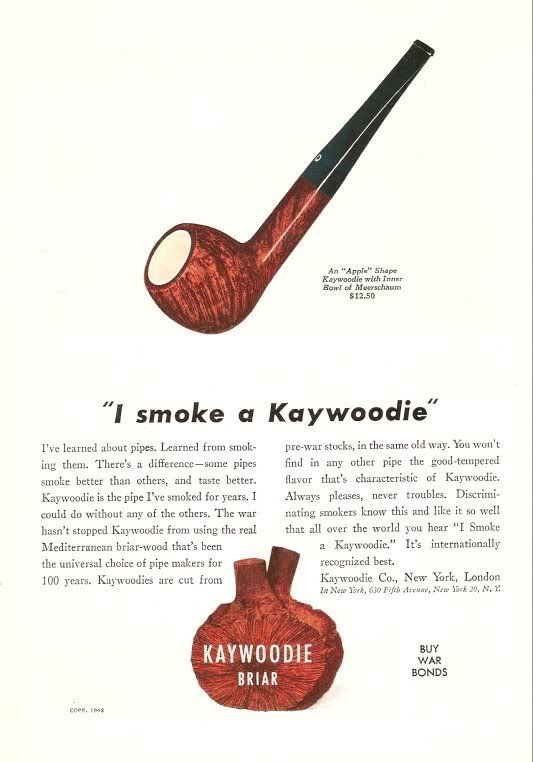
Vintage Ad (1943): "I Smoke a Kaywoodie"


As I mentioned before, Kaywoodie made a big selling point out of advertising their use of real Mediterranean briar, because they had large stockpiles of it and during the war there was no way to import more. Some other U.S. pipe makers ran out and tried to use American briar, which is not fit for pipes by any means.

Based on inflation, the pipe above would cost $140 right now. That was a lot of money to be shelling out for a pipe in 1943. An expensive pipe like this was certainly at least a Prime Grain, but more likely was a Flame Grain (both high-end Kaywoodie grades). With wood of this quality, the meerschaum insert is only a sales gimmick--it wouldn't improve the smoking qualities at all, except in that the usual cake build-up would be neither necessary nor even desired.

During this era, Kaywoodie stopped using a white cloverleaf logo and instead used a white circle with a black cloverleaf outline in the center of it. The logo could be either on the top or side of the stem.

Saturday, November 22, 2008

Featured Pipe Smoker: Aaron Spelling


Aaron Spelling (1923-2006)

Born in Dallas, Texas, Aaron Spelling served in the Air Force (at that time I think it was known as the Army Air Corps) before attending Southern Methodist University in Dallas and graduating in 1949 with a Bachelor of Arts degree.

His first foray into showbiz was as an actor, with a small part in the movie Vicki in 1953. He also acted in several movies and TV shows, such as I Love Lucy, Gunsmoke, and Alfred Hitchcock Presents. However, his success came in writing and producing. His first work at producing was for Zane Grey Theater in 1957. He continued to produce TV shows prolificly from then on, and was the producer for such notable series as The Mod Squad (1968), S.W.A.T. (1975), Starsky and Hutch (1975), The Rookies (1975), Family (1976), Charlie's Angels (1976), Fantasy Island (1977), The Love Boat (1977), Hart to Hart (1979), Dynasty (1981), T.J. Hooker (1982), and Melrose Place (1992), plus a lot of others.

His huge mansion was considered by some outrageously extravagant even by Hollywood standards, and is supposedly the largest single-family dwelling in California. He has a place in the Guinness Book of World Records as the most prolific television producer. He is listed as producing over 200 TV shows by imdb.com.

His children Tori Spelling and Randy Spelling are both actors.

He was said to have been a lifelong smoker until he was diagnosed with oral cancer in 2001. He suffered a stroke on June 18, 2006 and died from complications related to the stroke five days later on June 23.

Wednesday, November 19, 2008

Vintage Ad (1972): Ronson Pipes


So it appears that Ronson, now known primarily for its lighter fluid and little else, once made and sold pipes. This is another gimmick pipe in the pattern of the Falcon, by which I mean it had a metal body with interchangeable screw-on briar bowls. The only Falcon I ever had didn't use any filters, however.

But the real gimmick here is the "labyrinth of passages" in the stem which were supposed to duplicate the length of a nine-inch churchwarden and thereby produce a cooler smoker. Did it really work? I have no way of knowing, but I'd guess it's more gimmick than real effect. The metal rod attachment that's part of the bit looks very much like the Kirsten design, so I don't know exactly how the "labyrinth" worked, but anything with a "labyrinth of passages" in the stem sounds to me like it would be very difficult to clean. Although I suppose it could be cleaned pretty well using a pipe retort.

Saturday, November 15, 2008

Featured Pipe Smoker (Art): Shoshone Warrior with Pipe by Alfred Miller


Shoshone Warrior with Pipe by Alfred Jacob Miller

Not a person, but a painting of someone whose name is apparently lost to history. According to the book I scanned this from, the artist said the warrior's pipe was "the great solace of his leisure hours."

As for the artist, Alfred Jacob Miller (1810-1874) was born in Baltimore, and it is written that he was the first artist of his generation to explore the American West. He accompanied an expedition led by Sir William Drummond Stewart in 1837, following a route that later became known as the Oregon Trail. He witnessed one of the fur trappers' annual rendezvous on the Green River in what is now Wyoming.

After the expedition, he returned to his home town of Baltimore, where he remained until his death, creating many works of art based on the sights he had seen during his journey into the west. Few people knew of his works during his lifetime, and it wasn't until after his death that his art came to the attention of the general public.

An entry on Miller with many links leading to online exhibitions of his work can be found at artcyclopedia.

The pipe in the portrait is made of a wooden (or perhaps, cane or reed) stem with the bowl undoubtedly carved from the rock known as pipestone or Catlinite.

Wednesday, November 12, 2008

Vintage Ad (1946): Van Roy


Kaywoodies were famous (or infamous, to some) for their screw-in stems. However, they had a problem of eventually getting off-center because of the very slight wear to the fitment threads every time the stem was removed and replaced. Kaywoodie tried to fix this by making each pipe with a slightly off-center rightward cant. That is, if you held the new pipe in your mouth, the bowl would cant slightly to the right. As time went by, it would eventually line up dead center. Of course, as even more time went by, it would begin slanting slightly leftward due to continuing thread wear.

So Dr. Grabow (also famous or infamous, depending) came up with the "Ajustomatic" screw-in stem. Similar to Kaywoodie's, except that the screw-in fitment wasn't fixed as tightly and permanently into the stem. That way one could use just a little extra force to line up the bowl and stem at the desired angle. But if you fiddled with it too much, or it just wore out from age and use, it became very loose and you'd pretty much just have to go buy yourself a whole new pipe.

Since this ad uses the term "Ajustomatic," I must assume that Van Roy was another variety of Dr. Grabow.

Saturday, November 8, 2008

Featured Pipe Smoker: Aleister Crowley


Aleister Crowley (1875-1947)

What can I say about Mr. Crowley? If you know of him, it would be hard for me to say anything that you don't already know. If you don't know of him, there's more to say than I can write here.

Born Edward Alexander Crowley, his family were members of a conservative evangelical Christian sect called the Plymouth Brethren. His father had become quite wealthy in the brewery business, and had already retired when Aleister was born. During his retirement, his father dedicated himself to preaching. As sometimes happens in even the best of families, he rebelled against his family's strict Christian beliefs and went in other directions.

Crowley is probably best known these days as an outspoken occultist, and perhaps his most famous statement was, "Do what thou wilt shall be the whole of the law." Say what you want about him, but I don't think anyone can argue that he didn't practice what he preached.

Crowley was also a master chess player, a mountain climber, poet, writer, painter, astrologer, drug experimenter (and addict) and a philosophical commenter. He was also sometimes accused of racism and mysogyny. During his time he was called "the wickedest man in the world" and liked to refer to himself as "the Great Beast 666," among other things.

He became involved in occult matters as a young adult with the Golden Dawn, but as was his way, he eventually broke from them and founded his own occult philosophy, known today as Thelemic Mysticism. He practiced many forms of "magick," involving meditation as well as sex and drugs (rock and roll having not yet been invented).


As for his pipe smoking, I have no way to verify it, but I have read on more than one occasion that Crowley liked to smoke straight Perique flavored with rum. The flavoring of tobacco with rum is an old tradition and is not especially remarkable. However, smoking straight Perique may be described to the non-pipe smoker as eating a meal of straight jalapeño peppers and nothing else. Some people can do it, but not many would enjoy it. A thorough description of Perique would require me to write a whole new post, but for now I'll just say that it is created by aging the leaves under pressure and allowing them to ferment in their own juices for a length of time. This creates a very strongly flavored and pungent tobacco. It is normally used as a "spice" tobacco, that is, it is added to blends in small amounts for flavor, the way you might add salt or spices to food.

Crowley, having squandered his inheritance throughout his life, died penniless and addicted to opium of a respiratory infection in 1947.

Wednesday, November 5, 2008

Vintage Ad (1960): Wally Frank


Wally Frank was another pipe maker from the United States that seems to have developed a sort of cult following among collectors of cheaper pipes. Every time I sold one on eBay there was a flurry of bids for it and the final bid always surprised me at how high it went.

Here's one in which they combine at least three different gimmicks:

1. Threaded interchangeable bowl.
2. Pre-caked bowl.
3. Aluminum "radiator" stem.

Not that there's anything wrong with any of these gimmicks, or anything wrong with this particular pipe. However, breaking in a new pipe that has a completely naked inner bowl is not torture. I've always enjoyed it, actually.

Wally Frank also had something going for a while that might get modern nannyists into a frothing fit. They had a "Pipe of the Month Club." Members would receive a brand new Wally Frank pipe in the mail once a month. Of course, several tobacco distributors have had the same kind of program, at one time or another.

I've had a few Wally Franks pass through my hands. They were decent pipes. Nothing spectacular, but fine smokers nonetheless. Every one I had, I eventually resold, mainly because they kept selling so high. I mean, if I pay ten bucks for a box full of old pipes, and the Wally Frank sells for more than I paid for the entire lot, it's hard to not sell it.

Sunday, November 2, 2008

Poll results

Question: What does the tonquin flavor in 1792 Flake smell/taste like to you?

28 Responses:

Chocolate -- 2 (7%)
Vanilla -- 2 (7%)
Chocolate Coffee -- 2 (7%)
Vanilla Coffee -- 2 (7%)
Tonquin, of course! -- 7 (25%)
Chicken -- 0
Blasphemous scents from outside the spectrum of mortal sensation, of which no man may breathe the noisome vapours and still remain wholly sane. -- 11 (39%)
Other -- 2 (7%)

Thanks for playing!

Saturday, November 1, 2008

Featured Pipe Smoker: George Lincoln Rockwell

George Lincoln Rockwell (1918-1967)

It may well be impossible to find a neutral account of George Rockwell's life. I will try to stick to the facts as I know them (and even they may be wrong), and avoid editorializing.

Born in Bloomington, Illinois, Rockwell's parents were both vaudevillians and actors. Though brought up as a Christian, he later considered himself an agnostic; still later, he identified himself with the racist "Christian identity" movement. He attended Brown University in Providence, Rhode Island and majored in philosophy. In 1939 he quit school to join the U.S. Navy, since he had come to the conclusion that war with Nazi Germany was unavoidable. He attended flight school and earned his wings in 1940. He served in the Pacific theater and participated in the retaking of Guam.


After the war, he became a commercial artist, opening a photography studio and painting signs. In 1948 he won a $1,000 award for an ad he made for the American Cancer Society. He civilian life was interrupted when he was recalled to active duty at the beginning of the Korean War. He served in California, training Navy and Marine pilots.

Rockwell was married twice but had no children (as far as I can tell).

During his time in California he became an ardent anti-communist and supporter of Joe McCarthy. He also supported Douglas MacArthur's bid for president, adopting the corncob pipe in emulation of the famous photo of MacArthur.

In 1958 he protested the sending of U.S. troops to the Middle East. An admirer sent him an enormous swastika flag, which he turned into the centerpiece of a shrine to Adolf Hitler. He soon became a leader in the American Nazi movement, making white supremacy the focus of his political activism.

In 1959 he formed the American Nazi Party. He ran the lecture circuit, and was in high demand, lecturing against non-whites, Jews, and communists (he considered Jews to be communists anyway). He formed alliances with the Ku Klux Klan and other supremacist groups. In 1967 he changed the name of the American Nazi Party to the National Socialist White People's Party (apparently completely missing the irony of claiming to be an opponent of communism while simultaneously calling himself a socialist). He was also a holocaust denier (surprise, surprise).

Rockwell died of multiple gunshot wounds on August 25, 1967. The man convicted for his murder was one of his own followers whom he had been feuding with, but there is still some debate as to the real identity of his murderer.

Upon being informed of Rockwell's death, his own father is said to have stated, "I am not surprised at all. I’ve expected it for quite some time."

Wednesday, October 29, 2008

Vintage Ad (1944): Kaywoodie Pipes--Raking Leaves


Another Kaywoodie ad from World War II, with art by Rudolf Wetterau that has an autumnal theme. Sentimental thoughts of home in the war year of 1944, depicting the ancient tradition of leaf-burning.

"Many Kaywoodies go direct to our fighting men -- please be patient if your dealer temporarily can't supply you." Orders from soldiers were given priority over those from civilians, and of course, "war bonds come first." Don't buy a pipe if you know you have greater priorities.

Saturday, October 25, 2008

Featured Pipe Smoker: Albert King


Albert King (1923-1992)

Born into a poor farming family in Indianola, Mississippi, he was one of 13 children, and his real name was Albert Nelson. Perhaps his first musical influence was his own father, who also played guitar. King also sang in a family gospel group as a child, and briefly played drums before settling on the guitar.

Albert King came to also be known as "The Velvet Bulldozer" because of his size (6'4" and 280 pounds). He began guitar on a homemade instrument that he made himself and played the guitar "upside down and backwards" because he was left-handed. Although he later played on a custom-made left-handed instrument, he still strung it in reverse because that's how he was used to playing it. He also developed his own way of tuning the strings, keeping the higher strings "slacked," or not tuned as tightly so the notes they played were somewhat lower. His large, strong hands also allowed him to play dramatic, sweeping bent notes.


In this photo, Albert King demonstrates the advantage of being a pipe-smoking guitarist over being, say, a pipe-smoking saxophonist like Archie Shepp (who will be featured here sometime in the future).

Albert King is one of those musicians whose influence continues to be felt down through the generations, not only in blues, but in R&B and rock as well. Some later guitarists who counted Albert King as one of their biggest influences are Eric Clapton, Jimi Hendrix, and Stevie Ray Vaughan (the last of which will also be featured here sometime in the future).

Albert King died of a heart attack in Memphis, Tennessee in 1992.

Wednesday, October 22, 2008

Vintage Ad (1946): L.H.S. Sterncrest


That Bau-Bau is a serious pipe. Kind of makes that Sterncrest look wimpy in comparison.

Saturday, October 18, 2008

Featured Pipe Smoker: Andie MacDowell


Rosalie Anderson "Andie" MacDowell (b. 1958)

Andie MacDowell (imdb link) was born in South Carolina. During her teen years, her mother died, and she worked low-paying restaurant jobs to help support her family.

She attended Winthrop College (now Winthrop University) in South Carolina but dropped out in 1978 to pursue a career in modeling, and became successful as a model for L'Oreal. In 1984 she made her film debut in Greystoke - The Legend of Tarzan, Lord of the Apes (although Wikipedia says her voice was re-recorded by Glenn Close).

The film that pretty much established her as an actress was Sex, Lies, and Videotape in 1989. As of this writing, imdb.com lists her as an actress in 39 films.

She currently resides in Asheville, North Carolina. She is one of the very few famous female pipe smokers who I know of.

It's sometimes difficult to tell if some celebrities actually smoked a pipe off-screen or if the photo I have found is just some movie still or publicity photo "stunt pipe." One indication is to look closely at the pipe. In this picture, it is obvious that there is smoke coming from the pipe. The bowl is still full enough that a tiny bit of what appears to be tobacco leaves--or at least, something--is in the bowl. The end of the stem is in her mouth. She's smoking the pipe.

There are some reports on the internet that at some point she became "a closet cigarette smoker." She enjoyed smoking, but was embarrassed to be "outed." She was born and raised in tobacco country. All these things lead me to believe that yes, she is really smoking the pipe.

I can't ID the pipe, but it is interesting in that it has an unusual square shank and stem.

By the way, for an example of an actor who obviously wasn't a pipe smoker, try to catch the episode of The Dick Van Dyke Show called "The Meerschatz Pipe." First of all, the word is "meerschaum," not "meerschatz." And throughout the entire episode, Maury Amsterdam carried that pipe around like it was a dirty diaper or something. He had obviously never touched one before in his life. It was a wonder he didn't break the thing, the way he was slinging it around by its stem.

Also by the way, "meerschaum" means "sea foam." So I think you can guess what "meerschatz" would mean. (No, it doesn't really mean what it sort of sounds like. It means "sea treasure").

Thursday, October 16, 2008

Smoking the dregs

Yesterday I packed the last of the 1792 Flake into a pipe. There was nothing left. I think this is the first time any tobacco has "come out even" so to speak. I guess I was using just the right pipe.

Today I took out the last dregs of C&D Gray Ghost that I've had sealed up (with the Pump 'n' Seal) for a few months, dumped some Perique into it and mixed it up. This still remains one of my favorite smokes, and it was good to have it again. A few minutes ago I loaded up a pipe with what was left, then topped it off with some Haunted Bookshop that has also had extra Perique added to it.

Why go to this trouble? Ah, so hard to explain. Or perhaps not. I have a few more jars of C&D samples that I know I will smoke but will probably not enjoy so well. My next order will be several pounds in bulk, enough to last me for years. Probably.

But there are tins back in there that I fear to open. They tease me. They taunt me. Escudo, which I've had before and I know I will thoroughly enjoy; so thoroughly that I will probably not smoke anything else after I've opened the tin. And St. James Woods, which has been recommended to me so highly that I'm sure it will be another favorite.

Oh, but I still have several disks of Bullseye Flake that might hold me over for a few days, putting off the inevitable opening of another tin. I managed to stop myself before I had smoked all the Bullseye, but I know once I start again it will be all over.

Planning the next order is sometimes difficult, sometimes not. I've pretty much decided on what to order next time. One pound each of C&D's Bayou Night, Gray Ghost and Exclusive. Two tins of 1792 Flake. Several ounces of Bullseye. Some straight Perique.

My tastes continue to lean more and more toward Virginia and Perique blends, the exception being Gray Ghost which has maduro in it. Lately I've been carrying C&D's Stanhope in the truck.

Stanhope has an on-again-off-again relationship with me. The first time I tried it, I thought it was one of the best things I'd ever smoked. The second sample, a year or two later, didn't thrill me so much. This latest sample is somewhere in between. It seems to have almost a velvety texture this time, and the latakia is now quite noticeable. I've steered away from latakia since I developed such a love for Perique, and it seems I've developed a sensitivity to it. Where I once loved all I could get, I now think that most latakia blends have too much and would be improved with less.

And I do miss having Bayou Night. It still remains my favorite smoke, anytime of the day or night. But unfortunately, if I have it on hand I tend to reach for it over anything else, and it doesn't last long.

What's the point of this post? No point. Just some rambling thoughts on pipe tobacco.

Wednesday, October 15, 2008

Injun Summer

Date unknown, but from an old issue of the New York Daily News Sunday edition, according to Sad Old Goth.

Click to enlarge for a more readable version.

(Not an ad, but I'll put it in that category anyway to keep things simple).

Tuesday, October 14, 2008

Vintage Ad (1947): Yello-Bole Pipes


The Yello-Bole, one of the more famous gimmick pipes, which may take some explanation for non-pipe smokers.

All pipe smokers (pretty much) are concerned about cake. Cake is the build-up that occurs inside a pipe bowl as it is smoked. A pipe with just the right amount of cake generally smokes better, cooler, and drier than a new, uncaked pipe. Some newbie pipe smokers get kind of worried when they don't see cake building up right away, and there are all kinds of tricks to speed cake build up. One of these tricks is to get a little drop of honey on your finger and swipe the inside of a new pipe with it to get the ash to stick better. This provides a sort of foundation for cake build up. This isn't because honey somehow has some kind of magical properties when it comes to pipes, it's simply because it's sticky, and being edible, there are no harmful fumes if it gets toasted a little. The same effect can be had by using a drop of saliva.

Almost every pipe company that has ever been has had what is called a "seconds" line. Seconds are pipes that, for one reason or the other, didn't quite measure up to the standard of the company to earn the company's actual brand name. It's just about impossible to know if any given burl of briar is going to be flawless; most aren't. Some are more flawed than others. But still, buying briar costs money, and labor had to go into the making of a pipe, so they don't want to just throw away a pipe because there might be a tiny sandpit or two in the briar. For example, Peterson pipes sell their seconds under the name "Irish Seconds." These are pipes that are still perfectly good smokers, they're just not quite perfect enough to warrant the name "Peterson." Everybody knows Irish Seconds are actually cast-off Petersons and that they are, in general, still very good pipes.

The brand known as Yello-Bole is actually Kaywoodie's seconds line. Since Kaywoodie already had several grades for their pipes, a pipe that didn't live up to the Kaywoodie name must have been pretty far down the ladder.

Kaywoodie went one better on their seconds, and not only did they call them by a different name, but they came up with a whole new gimmick to sell them. The inside of the bowl is coated with "honey."

I say "honey" in quotations because, of course, it isn't real honey. Honey may be one ingredient, but it's still a dry, yellow substance instead of a liquid, golden-brown substance. They claimed that it made them smoke cooler, better, so forth and so on, like all gimmicks are supposed to do when it comes to pipes. After a few bowls, the yellow stuff would be all gone, and you would still have to build up a normal cake anyway.

Finding a Yello-Bole these days that still has the original yellow cake intact is probably very uncommon. In my used-pipe buying days I found one that someone must have broken out of the package, tossed in his desk drawer, and never looked at again. It had several bids, and sold for probably 4 or 5 times what it originally cost back in the 1950s.

The one in the ad above even looks like a Kaywoodie, with a screw-in stem and the logo right where the Kaywoodie cloverleaf would be on the stem. The Yello-Bole logo was a golden circle.

My own attitude toward cake has always been somewhat relaxed. It just happens. Depending on a pipe smoker's frequency of using any given pipe, the tobacco used in it, and even the pipe itself, cake will happen sooner or later. It's always going to happen eventually, so don't get too worked up about it if it doesn't come along as soon as you think it should. Eventually, you will be breaking out your pipe tool and reaming a little cake out of it because it's getting too thick. So just enjoy your pipes and don't worry about the cake.

Sunday, October 12, 2008

The Poll on the left

In the left sidebar is a quick & dirty poll that I put together with Blogger's new(ish) "create your own poll" gadget. As you can see from the available choices it is somewhat tongue-in-cheek. If your choice is "other," please leave a comment trying to describe what it does taste like to you, and later on I'll put all the descriptions together in one post.

Saturday, October 11, 2008

Featured Pipe Smoker: "Old" Tom Morris


Old Tom Morris (1821-1908)

Tom Morris, Sr., (pictured here in 1896) better known as Old Tom Morris, was born in St. Andrews, Scotland. He started his career in golf apprenticed to "featherie" ball maker Allan Robertson (Robertson is known as the world's first golf professional). When new ball technology made the featherie obsolete, Robertson opposed the new ball. Morris simply went his own way and began making his own balls. He was also a club maker, course designer, and champion golfer.


Morris won four Open Championships during the 1860's, and is the oldest person ever to win the Open Championship, at age 46. He was Keeper of the Greens at Prestwick from 1851 to 1864, and Custodian of the Links at St. Andrews for nearly 40 years, until he retired in 1902.

Some of the courses he designed are Prestwick, Royal Dornoch, Muirfield, Carnoustie, Royal County Down, Nairn and Cruden Bay. His fee was £1 per day plus expenses. He standardized the golf course at 18 holes, introduced the idea of placing hazards so the ball could be routed around them (previously they were just there and you had to deal with it), and introduced the course design concept of each nine holes returning to the clubhouse.

Old Tom passed away in 1908, a few months after sustaining a fractured skull from falling down the stairs at the clubhouse.

Wednesday, October 8, 2008

Vintage Ad (1932): Granger Tobacco


Yaaaaggghhh!!! Passive smoking!!! Passive smoking!!!

My kids love it when I blow smoke rings. Unfortunately, that's not something I can do very well when I'm thinking about it, although I have made some very impressive ones unconsciously. It's sort of a pipe-smoking Zen thing.

Saturday, October 4, 2008

Featured Pipe Smoker: Günter Grass


Günter Wilhelm Grass (b. 1927)

Author, poet, playwright and sculptor Günter Grass, who seems almost never to be photographed without a pipe. Born in Danzig, Germany (now Gdańsk, Poland), and since 1945 has lived in West Germany. His works have a strong leftist leaning, and he is a supporter of the Social Democrat Party of Germany. His most well-known book is The Tin Drum (Die Blechtrommel) from 1959.

During the 1980s, he argued against reunification of East and West Germany, stating that a united Germany would once again assume its old role as a belligerent nation-state. Many of his essays deal with the idea that the people of Germany should still share a collective guilt from the activities of the Nazi regime of the 1930s and '40s.

Conversely, Grass volunteered for U-boat duty in 1942 at the age of 15. He was not accepted, but was conscripted into the Reichsarbeitdienst (Reich Labor Service). Later in 1944, he was called up for service in the Waffen-SS and trained as a tank gunner, serving with the 10th SS Panzer Division. He was wounded in battle in 1945, captured and sent to an American POW camp.

Some have castigated Grass for seeming the hypocrite, others say his latter-day confession of membership is a publicity stunt to sell books. Still others dismiss it as a youthful error. He was a teenage male in World War II Germany--he would have had to serve somewhere, it seems, or face execution.

Günter Grass is another of those rare pipe smokers who is widely reviled by other pipe smokers, not because of his questionable politics, but because of the way he keeps his pipes. Although I personally have no first-hand knowledge of this, it is said that he is one of those who does not clean his pipes, therefore the smell of his pipe is more of a foul stench than a pleasing aroma.


Look closely at the pipe in this photo. You will notice that although the pipe is the typical dark brown of a well-smoked briar, the rim of the bowl is black. You will also notice the discoloration on the bit where his lips clamp around the stem.

The black rim is caused by tar build-up from burning tobacco. This is what happens if you don't wipe clean the rim occasionally. The discoloration on the stem is what happens when saliva gets on vulcanite (rubber) and is exposed to air and sunlight. Both can be prevented by cleaning the pipe every now and then.

I will admit that a couple of my truck pipes look similar to this. However, I also keep pipe cleaners and cleaning fluid in my truck so that I can regularly clean the insides and keep them smelling sweet.


Look at the bit of this pipe. Come on, Günter, clean your pipes!

I am also not a very public figure who is frequently photographed with a pipe. If I were to be photographed with a pipe, you can bet it wouldn't look like this.

Wednesday, October 1, 2008

Vintage Ad (1931): Dill Tobacco


Throughout my pipe-smoking lifetime, I have never seen anything from Dill except for pipe cleaners. But at one time, they also marketed tobacco.

Saturday, September 27, 2008

Featured Pipe Smoker: William Moffett


Rear Admiral William Adger Moffett (1869-1933)

Born in Charleston, South Carolina. He graduated from the U.S. Naval Academy in 1898.

Moffett was not a pilot himself, but he came to be known as the "father of naval aviation" for his leading role in developing naval aircraft tactics and the introduction of the aircraft carrier.

He died in the crash of the dirigible Akron, which went down during a storm off the coast of New Jersey in 1933.

One ship, the USS Moffett, was named after him, and so was Moffett Field in California.

A short biography, as well as a detailed account of the crash that took his life, can be found at the website of Arlington National Cemetery, where he is interred.

Wednesday, September 24, 2008

Mixing your own

Recently there was a question at My Pipes Community about blending your own tobacco. Now, professional tobacco blending is a real art form that requires extensive knowledge and experience, plus a healthy dose of natural talent like any other art. However, there's no reason why the casual pipe-smoker can't have fun doing some kitchen table blending on his own.

A first recommendation: blend small amounts. If you screw up and create the most mind-numbingly horrible tobacco ever invented, you want to be able to throw it away without losing too much of your inventory. Get a small digital scale that will measure very small increments, such as units of at most 1 gram and/or fractions of an ounce. Such scales are cheap and easy to find. I got one some time ago via eBay. Keep a record of what you mix and how you mix it.

Just because your good idea doesn't blow your mind when you first light it up doesn't mean it's a failure. Leaves of varying flavors need to meld together for a while. Allowing time for the leaves to "marry" almost always improves the flavor. My method is to put the new mix in a jar and shake it up real good to get everything mixed, and then vacuum seal it. I have Food Saver vacuum sealer and I use the bags-on-a-roll so I can cut my own size bags. The vacuum-sealing not only helps to preserve it, but also when the bag squeezes down on the tobacco it has a "pressing" effect. If you let such a bag sit for a few weeks, you will have to tear off hunks and rub them out before loading them into a pipe. And yes, I said "a few weeks." I have a general rule of not declaring a new mix a success until I've had an ounce or two vacuum sealed for at least a month so I have a decent sample to pass verdict on.

But where to start, and what to use? I've been a big fan of Cornell & Diehl for a long time, and Mr. Tarler will sell straight leaf of just about anything for your own personal blending experiments. If you order one of the 5- or 8-item samplers, you should be able to get just about every kind of leaf you need. Of course, there are many other places to buy straight leaf, just check around.

One good way to start is if you have a particular liking for a certain kind of "spice" tobacco such as Latakia or Perique. Try adding varying amounts of your favorite spice leaf to already established blends to spice it up a little and make it even more to your liking.

I have come up with two successes so far by adding a spice leaf to already existing blends. One is made by using C&D's Gray Ghost (Virginia and maduro) and adding Perique. The ratio is 13/16 GG and 3/16 P. I do it in increments of 1/16 because when you do come up with something good and you want to order it in bulk, it makes it much easier for Mr. Tarler to mix up your custom blend (each 1/16 becomes a full ounce when ordered by the pound). I call this blend "Don't Tread On Me." The version above is the "mild" version, and is more forgiving to innocent bystanders (it is quite robust). The version I really prefer is stronger, and mixed 5/8 GG to 3/8 P.

The other I haven't really named yet (well, in my experiment spreadsheet I call it "Nightgaunt"), but it is made by mixing 7/8 Yale Mixture (C&D blend of Virginia and Latakia) with 1/8 Perique. Yes, I am a real Perique lover, and I always have some straight stuff on hand for blending experiments.

I don't usually start out by measuring everything exactly. I usually start by just throwing a couple of bowls worth together and giving them a try to see if I want to go further with it. A couple of days ago I threw together some Perique and Balkan Sasieni. I didn't measure it, but it was roughly 70% Perique. It was good and had a real kick. Today I mixed up some Perique with C&D's Oriental Silk (which already has some Perique in it), at about 50/50. This one is actually quite good and I think I'll be refining it in the future.

I don't have any advice for mixing aromatics. I don't care for most aromatics and I have never done any such experimentation with them. Although now that I think about it I can't help wondering what 1792 Flake would be like with a little Perique mixed in.

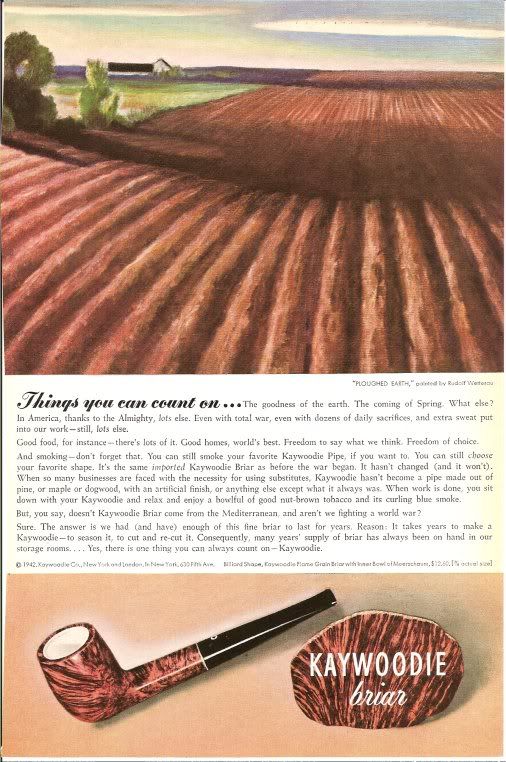
Vintage Ad (1942): Kaywoodie--Plowed Earth


Rudolf Wetterau (1890-1953) was a commercial artist specializing in landscape and still life paintings. Several of his works were used for Kaywoodie ads during the 1940s.

If you read the writing on this ad, you can see how it specifically refers to the situation during World War II.
Things you can count on...The goodness of the Earth. The coming of Spring. What else? In America, thanks to the Almighty, lots else. Even with total war, even with dozens of daily sacrifices, and extra sweat put into our work--still, lots else.

Good food, for instance--there's lots of it. Good homes, world's best. Freedom to say what we think. Freedom of choice.

And smoking--don't forget that. You can still smoke your favorite Kaywoodie pipe, if you want to.
The ad goes on to discuss the situation with briar during the war. There were no ships available, nor was it even safe, to import Mediterranean briar during the war. And thus was born that little stamp with which all pipe smokers are now familiar: "IMPORTED BRIAR." To most this probably only seems to be some odd, nonsensical sales gimmick. After all, all briar is imported.

The IMPORTED BRIAR mark began during World War II so pipe smokers would know their pipe was made from the good stuff. Some U.S. pipe companies ran short of briar during the war, when none was being imported. So there were many pipes made from other materials, some of which worked, some of which didn't work so well, but none of which worked as well as imported briar. Maple, olive and cherry wood can make passable pipes, but some other experiments were distastrous. For example, there were attempts made to create pipes from American briar. Unfortunately, the briar that grows on the American continents is not the same as that which grows in the Mediterranean area and is not suitable for pipe-making by any means.

Kaywoodie had enough briar warehoused to last for several years, and they and some other makers wanted to make sure their customers knew that their pipes were still made from good Mediterranean briar. So today we still have thousands of pipes stamped with IMPORTED BRIAR.

As for the pipe pictured in this ad, this was a top-of-the-line meerschaum-lined Flame Grain that sold for a whopping $12.50 in 1942 (equivalent to $157 today, adjusted for inflation). Lining the inside of a briar bowl with meerschaum is just a gimmick (in my opinion, of course), it does not improve the smoking qualities of a pipe, especially a pipe like the Flame Grain that was made from better-than-usual-quality briar. But smaller chunks of meerschaum that were not big enough to be made into a pipe had to be used for something, or the money that bought them would be wasted. Turning them into small liners for briar pipes gave them one more sales strategy. In fact, I'm not sure these liners were made from block meerschaum. They may have been made from pressed meerschaum, created from the cast-off shavings from carving a meerschaum pipe. In either case, this was only a way to save some material rather than throw it away.

Of course, meerschaum-lined briar pipes are still being made, because it's a gimmick that still sells pipes.

Monday, September 22, 2008

Pipes in Literature: Feathertop

"Dickon," cried Mother Rigby, "a coal for my pipe!"

The pipe was in the old dame's mouth when she said these words. She had thrust it there after filling it with tobacco, but without stooping to light it at the hearth, where indeed there was no appearance of a fire having been kindled that morning. Forthwith, however, as soon as the order was given, there was an intense red glow out of the bowl of the pipe, and a whiff of smoke came from Mother Rigby's lips. Whence the coal came, and how brought thither by an invisible hand, I have never been able to discover.
Thus begins Feathertop by Nathaniel Hawthorne. I recommend you quit wasting time here and go read it forthwith.

Thanks to Brer for the clue. (Go read that link too. It's very interesting.)

Saturday, September 20, 2008

Featured Pipe Smoker: Burl Ives


Burl Ives (1909-1995)

Born in Illinois, Burl Ives dropped out of college in the 1930's and became a traveling minstrel, working odd jobs, singing and playing his banjo. During the 1940's he had his own radio show called The Wayfaring Stranger, after an old folk spiritual. Although he was in several movies, he is of course best remembered as a folk singer.

He was once jailed in Mona, Utah during the 1930's for singing "Foggy, Foggy Dew." The local authorities decided it was too "bawdy."

He cooperated with the House Unamerican Activities Committee, naming Pete Seeger and others as possible Communists. His cooperation ended his own blacklisting, which allowed him to return to movies.

During his travels across the country, he also collected and cataloged many folk songs that may otherwise have been forgotten. Some of these were published in a collection of simple sheet music called The Burl Ives Songbook, which I happen to have a copy of (a gift from Brer of PowerOfBabel). There is a song in this book called "Tobacco's But an Indian Weed." I have read that this piece of music may have been secretly written by King James I, and was originally titled "On the Religious Uses of Tobacco." However, the sentiment is so similar to Bach's So oft ich meine Tobackspfeife that I think it must be an Americanized (or at least, English-ized) version of the song, with different music.

Click the link below for a simple midi version of the song, which I transcribed myself from the sheet music in the book. Following are the lyrics.

Tobacco's But An Indian Weed
Tobacco's But An I...
Hosted by eSnips


Tobacco's but an Indian weed,
Grows green at morn, cut down at eve.
It shows our decay;
We are but clay;
Think of this, when you smoke tobacco.
The pipe that is so lily-white,
Wherein so many take delight,
Gone with a touch;
Man's life is such;
Think on this, when you smoke tobacco.
The pipe that is so foul within,
Shews how the soul is stained with sin;
It doth require
The purging fire.
Think on this, when you smoke tobacco.
The ashes that are left behind,
Do serve to put us all in mind,
That unto dust,
Return we must.
Think on this, when you smoke tobacco.
The smoke that doth so high ascend,
Shews that our life must have an end;
The vapour's gone;
Man's life is done.
Think on this, when you smoke tobacco.

Wednesday, September 17, 2008

More on the infamous 1792

Wow, it has been a long time since my first trial run of 1792 Flake. I didn't want to smoke it in the Kirsten again, because I wanted to smoke it in a regular all-briar pipe. But which pipe? Having heard scary stories about 1792 permanently flavoring a pipe made me wary. But I needed to smoke this leaf again. One smoke was not enough to form a valid opinion.

I don't think two smokes are enough, either.

So I finally decided on the unnamed Italian bent billiard sandblast. This pipe has always had an odd quirk of imparting its own flavoring to anything smoked in it (sort of chocolatey hints). So I figured nothing would be lost if it became permanently flavored with 1792. Also if you check the old post I mentioned that the tonka flavoring seemed to put me in mind of lightly flavored chocolate coffee. I decided this pipe would be a good match for it.

The bowl of this anonymous 'blast has significantly more volume than does the Kirsten, and it was a much longer smoke. In that first post (linked above) I mentioned that it made me thirsty. This larger bowl made that a problem. In fact, the thirstiness didn't go away for hours. I woke up several times during the night to drink water. This thirstiness effect will probably put me off 1792 for even a semi-regular smoke, but I think I will continue to keep it in my cellar. I am very interested in trying it outdoors and getting some opinions from innocent bystanders.

Room note? Oh, room note. Well, after finishing the smoke I went outside for a few minutes, and then came back in. The house in general was pretty much free of any smell, but inside my Sanctum, where I had smoked the pipe, the room note was not so much a note as a klaxon. Or maybe a gong. A big gong.

1792 Flake is not for the faint of heart. Or the faint of nostril. I think this would be a good barbecue smoke. When I barbecue, I also enjoy outdoors pipe smoking, and I usually stick with something fairly robust that is still noticeable--and that blends well--with mesquite smoke (C&D's Gray Ghost is my favorite barbecue smoke). I'm not sure yet how well 1792 would "blend" with mesquite, but it should have no problem beating it into submission.

Vintage Ad (1926): Tuxedo Tobacco


In 1926 Gilda Gray, then 25, was at the height of her career when her likeness appeared in this ad for Tuxedo tobacco.

Gray was born in Poland (as Marianna Michalska) and came to the U.S. with her parents as a child. She rose to fame in vaudeville and became known for her trademark dance, called the "shimmy." During the 20s she achieved some fame in the movies, but suffered seriously in the financial crash of 1929 and her career never really recovered. She died in 1959 at the age of 58. The Motion Picture Relief Fund paid for her funeral expenses.

During the Cold War era she worked to bring six Polish citizens to the United States, and after they were here she helped pay for their educations. For this she was decorated by Poland "for her interest and help to her countrymen and her country."

She didn't smoke a pipe, but apparently she liked men who did.

Saturday, September 13, 2008

Featured Pipe Smoker: J.S. Bach

Johann Sebastian Bach (1685-1750)

I know what you're thinking: Hey, he doesn't have a pipe! What's up with that? We got rooked! I have something extra in place of such a picture for this installment, but I'll get to that later.

Johann Sebastian Bach is such a prominent historical figure that there's not much I can say about him that you can't easily find elsewhere. His body of compositions--more than 1,000--represent the pinnacle of the Baroque era. Mozart, Beethoven and Chopin admired him greatly and were influenced by his work. Some musical scholars have professed the opinion that the Baroque period ended the day that Bach died.

But there is one small thing that sets him apart from them all. He once wrote a song about pipe smoking.

Found in the Noten-Bchlein vor Anna Magdalena Bach ("Little Notebook for A.M.Bach") of 1725 (Anna Magdalena was his second wife), this brief song was called So oft ich meine Tobackspfeife. I think the general meaning of this in English would be "thus is my tobacco pipe" or perhaps "and so is my tobacco pipe."

Based on the time during which Bach lived, I must say that he undoubtedly smoked clay pipes, because it was long before briar was discovered to be a wood made for pipes. Even more certain is the information held within this aria, which refers to a clay pipe.

Here follows an English translation of the original. Since this is more or less a literal translation, the meter and structure of the original poetry is no longer intact, but for my purposes here it will suffice. It was sent to me by someone on some pipe forum several years ago.
Whenever I pick up my tobacco-pipe,
Stuffed with good tobacco
For pleasure and pastime,
It gives me a sad impression -
And leads to the conclusion
That I resemble it in many ways.

The pipe was made from clay and earth
And so was I.
One day I will be earth again -
It often falls from the hand
And breaks before you know,
My destiny is the same.

The pipe is usually not colored;
It remains white. So therefore,
One day when I am dying
My body will turn pale.
Once buried it becomes black, just like
A pipe that has been used for a long time.

When the pipe is lit,
One sees the smoke disappear instantly
In the free air,
Leaving nothing but ashes behind.
The glory of all mankind is consumed
And the body turns to dust.

So often it happens while smoking,
That the stuffer is not handy,
And instead the finger is used,
Then I wonder when I burn myself,
If the ashes make such pain
How hot will it be in Hades?

Since such is the case,
From my tobacco I can always
Erect enlightening thoughts.
Therefore, in comfort I smoke
On Land, at sea and at home
My little pipe, with devotion.
Here is another translation thanks to Olivier at My Pipes Community.
Whene'er I take my pipe and stuff it
And smoke to pass the time away
My thoughts, as I sit there and puff it,
Dwell on a picture sad and grey:
It teaches me that very like
Am I myself unto my pipe.
Like me this pipe, so fragrant burning,
Is made of naught but earthen clay;
To earth I too shall be returning,
And cannot halt my slow decay.
My well used pipe, now cracked and broken,
Of mortal life is but a token.
No stain, the pipe's hue yet doth darken;
It remains white. Thus do I know
That when to death's call I must harken
My body, too, all pale will grow.
To black beneath the sod 'twill turn,
Likewise the pipe, if oft it burn.
Or when the pipe is fairly glowing,
Behold then instantaneously,
The smoke off into thin air going,
'Til naught but ash is left to see.
Man's fame likewise away will burn
And unto dust his body turn.
How oft it happens when one's smoking,
The tamper's missing from it's shelf,
And one goes with one's finger poking
Into the bowl and burns oneself.
If in the pipe such pain doth dwell
How hot must be the pains of Hell!
Thus oer my pipe in contemplation
Of such things - I can constantly
Indulge in fruitful meditation,
And so, puffing contentedly,
On land, at sea, at home, abroad,
I smoke my pipe and worship God.
And so, for Bach, his pipe was an example for his faith and a tool for his devotion.

To hear a simple midi version of this song, click the following link.

aria
aria.mid
Hosted by eSnips

Thursday, September 4, 2008

Dumbhill

From the Dunhill website's Terms and Conditions:
ALFRED DUNHILL does not authorise linking to its Web Site from a third party web site without its prior written authorisation.
As Jed said, "Yet another company that doesn’t understand the web."


Alfred must be whirling dervishly in his mausoleum right about now.

via Freedom Sight

Sunday, August 24, 2008

Vintage Ad (1963): Dr. Grabow Continentals


The Grabow is cheap and ubiquitous, still carried by certain pharmacy chains across the U.S. It was at the Walgreens that was once in the strip mall at Fredricksburg and Gardina (in San Antonio, Texas) that I bought my first pipe, and it was a Grabow, but it was not a Continental.

I have had very little exposure to the Continental series, in fact, I have held only one in my own hands. It was a refurbishing project, and it was in such beautiful shape that I decided I would either smoke it or sell it, but not both. I sold it. I don't remember the shape number, but it had the flat bottom of #24 in the picture above, but with the tall bowl of #20.

Based only on the one pipe that I briefly owned, I think these are higher quality than the usual drug store fodder.

And of course the Dr. G is "the world's only pre-smoked pipe." This was the Grabow gimmick, since everybody had to have a gimmick. Other ads, of which I'm sure I have one somewhere, show a drawing of their pipe-smoking machine: a rack of pipes (the metal kind) through with air is softly drawn (or pushed, I don't know which), automatically smoking the tobacco packed into many pipes at once. This does seem to create a paper-thin starter cake so the pipe doesn't have to be broken in. Theoretically. Many Dr. Grabow's are simply not made with enough briar, and the thin bowl walls and low mass of the wood just don't dissipate enough heat. They smoke hot, and no amount of gimmickry can change that.

I've always wondered exactly what kind of leaf they pre-smoke their pipes with. I suppose it's something relatively flavorless like burley, or possibly burley and Virginia.

There are some older Dr. G's that are good smokers, however, and many can be improved by sanding off the finish so the wood can breathe better. Although such sanding will expose all the fills and ugliness of the lower-grade briar used in these pipes.

I did this myself to another Dr. Grabow (not my first), and after sanding, just applied a wax polish to the bare briar. The fills are obvious now, but it smokes a lot better, and that's what counts for me.

I also thought the ad for the "B B Shot" was interesting.

Sunday, August 17, 2008

Featured Pipe Smoker: William Conrad


William Conrad (1920-1994)

Born in Louisville, Kentucky. William Conrad (born William Cann) began acting in his mid-twenties, but in the olden days before television, he provided the voice of Marshall Dillon when Gunsmoke was still a radio show. He did a lot of what is now called "voice acting," such as the announcer for The Bullwinkle Show, the voice of the Lone Ranger in the 1980 cartoon The Tarzan/Lone Ranger/Zorro Adventure Hour, and the narrator for Buck Rogers in the 25th Century. I remember him best as private detective Frank Cannon (I loved his long-range shots with that .38 snubby). People who are slightly younger than I might remember him better as the Fatman from Jake and the Fatman. Many of his roles were that of portraying a detective or lawman, but he sometimes also played the role of villain. He also reprised his role of Frank Cannon in a couple of episodes of another of my favorite old detective shows, Barnaby Jones.

He was active in show business for almost his entire life, his last television appearance being in 1993 on an episode of Bill Nye, the Science Guy. He was posthumously inducted into the Radio Hall of Fame in 1997.

Mr. Conrad was said to have had a large collection of Charatan pipes. The type of pipe he is smoking in this picture is usually called a "chimney" or "stovepipe" due to its tall bowl design.

Saturday, August 16, 2008

Vintage Ad (1949): The Kaywoodie Family Tree

click to enlarge

Here's a nice two-page ad from 1949 that I snagged from somewhere--I don't have the original paper copy. It was a little dim so I tried adjusting the brightness and contrast to bring the pipes out better, but the colors are a little off. For example, I don't think the billiard with the "plum finish" at bottom left was quite that purplish. Interesting finish, though. Clockwise from there is a "hand carved" Dublin (these kinds of deep gouges in the bowl are a real turn-off for me), bulldog, billiard "relief grain," and a pup. There were pups made in all shapes, this one is a bulldog, and were basically just miniature versions of the full-sized Kaywoodies. Cute, perhaps, and interesting for the collector, but small pipes like that generally smoke too hot because there's just not enough mass in the bowl. Next is a billiard sandblast, then a Rhodesian or a bull moose, whichever name you prefer, a poker with a meerschaum insert and another bulldog.

Starting at top on the right side we have a billiard shaped "Ninety-Fiver," a billiard Centennial which appears to have a very light or possibly no finish (unusual for a Kaywoodie), and then a Kaywoodie Carburetor. As you can see the Carburetor had a small hole in the bottom of the bowl so that theoretically a small portion of the air is drawn through the bottom of the pipe, mixing with the hotter air that has been drawn down through the tobacco, thus providing a cooler smoke. In my opinion this is just another gimmick that doesn't really have a noticeable effect. They also sold Carburetors as Yello-Boles, one of which I have so I have smoked this kind of pipe. After that is a Chinrester, which looks odd but is actually a very comfortable pipe. The Yello-Bole that I previously mentioned is actually a Carburetor Chinrester (two birds with one stone kind of thing). Then there is a Stembiter, which had an indentation in the end of the bit that was supposed to help prevent tooth damage from strong biters (did it work? who knows?). I had a couple of Stembiters at one time and the strange bit made no difference to me at all. Last of all is the Chesterfield, which was Kaywoodie's version of the Peterson System pipe. There is a small reservoir drilled in the shank which partially extends beneath the bowl to help drain away moisture from the stem. This is a trick which (in my opinion, of course) actually does do some good. I don't have a Chesterfield yet and acquiring one would be an excellent addition to my collection.

Tuesday, August 12, 2008

My pipe tool!

Many years ago I purchased a nice pipe tool--designed like a pocket knife--that has stainless steel bolsters in the shape of a pipe, with insets of rosewood. About three years ago I lost it. I knew where it should be, but I couldn't find it. I had given up hope.

My son just approached me with it. "Were you looking for this?" Eureka! He was snooping in the very place where I thought it should have been. I must have somehow overlooked it at least a dozen times.

Time to smoke a pipe!